.webp?width=40&height=40&name=Adobe%20Express%20-%20file%20(2).webp)


Preparing content progressions for units, writing lesson plans, making them engaging and varied...
Obviously, when we all first saw ChatGPT write a full lesson plan, that was pretty cool. But, that was officially three years ago. The situation has changed dramatically, and it's important to update our hopes and dreams (and basic expectations) along with it.
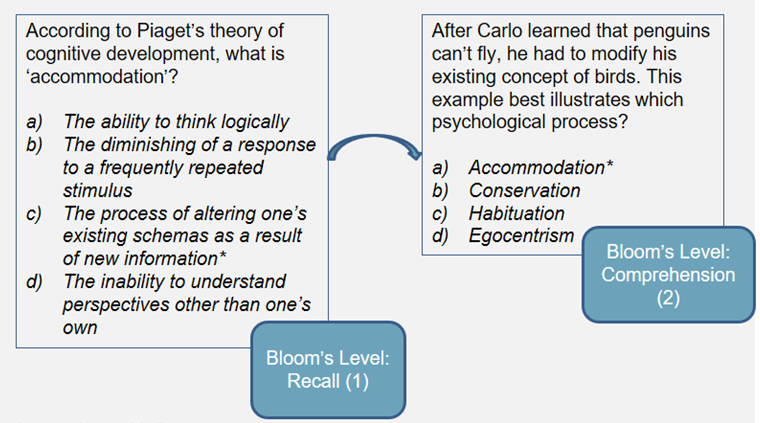
I would argue that as a group, we are officially past the "look at it go!" phase with AI. Yes, it can write a lesson plan, an activity, it can break down standards, it can make a rubric, it can write assessment questions... and anything else you tell it to do.
But, is it any good?
As we discuss in our new book, Irreplaceable: How AI Changes Everything (and Nothing) in Teaching and Learning, "the more things change, the more they stay the same." Good pedagogy is still good pedagogy. Learning is still learning. Having more materials of varying quality doesn't change that, it only makes it more urgent that teachers have the tools they need to sort through them and figure out what's right for their students.
Most platforms are leaving teachers to wrestle with that question alone. As if the AI has done its part, generating a learning material of whatever quality, and now it's just more work for the teacher to sift through the slop. This is why some studies are reporting that AI is not saving teachers time at all, and maybe even adding to their planning time!
Two things need to happen:
1) We need to bake mechanisms for higher-quality AI into our tools and
2) We need to create new kinds of tools, to support teachers' informed decision-making as they co-create their materials with AI.
While we have made some great progress on the first one, I want to focus here on the second one.
How can we support teachers in their pedagogical reasoning?
We are adding AI analysis tools, informed by learning sciences research, to assist teachers to interact with AI generated materials.
Here is the magical step:
Once you have a material (either generated or uploaded) you can see a personalized, inspectable, expandable analysis of the quality of that specific learning material. Keep modifying the material with the chat, and watch how the analysis changes in response!
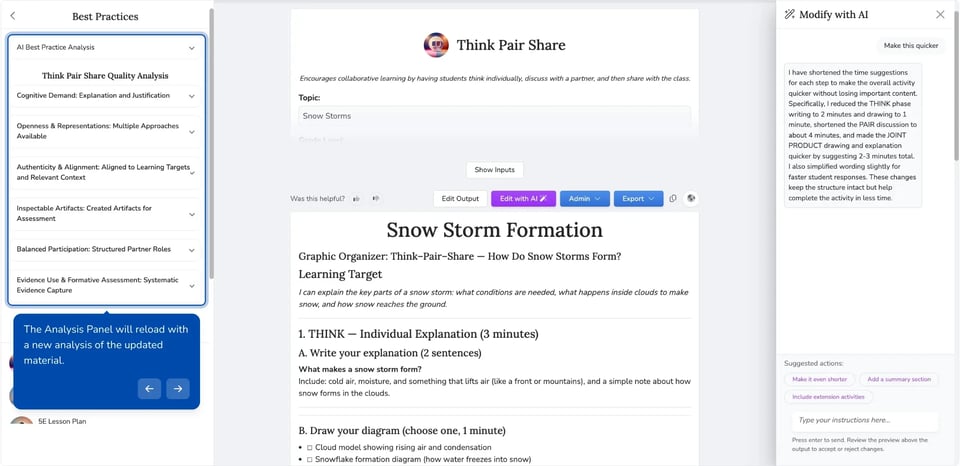
This is not only helpful for teachers in the moment, but embedded, actionable, precise, useful PD is known to be the best way to help teachers learn.
We are embedding learning sciences not just in the tool, not just in teacher interactions with the tool, but at the very core of the way we design our support for teachers.
So what do you think?
To try it out for yourself, see how it works for one of these three tools:
the Rubric Generator tool, the Think Pair Share tool and the 5E Lesson Plan Generator tool


What kinds of analyses should we add next?
We are eager to hear your feedback!